

Is Replacing Window Glass Worth It? Here’s What Chicago Homeowners Need to Know
Window replacement glass is one of the most cost-effective home upgrades you can make — especially if your windows are drafty, foggy, or cracked but the frames are still in good shape.
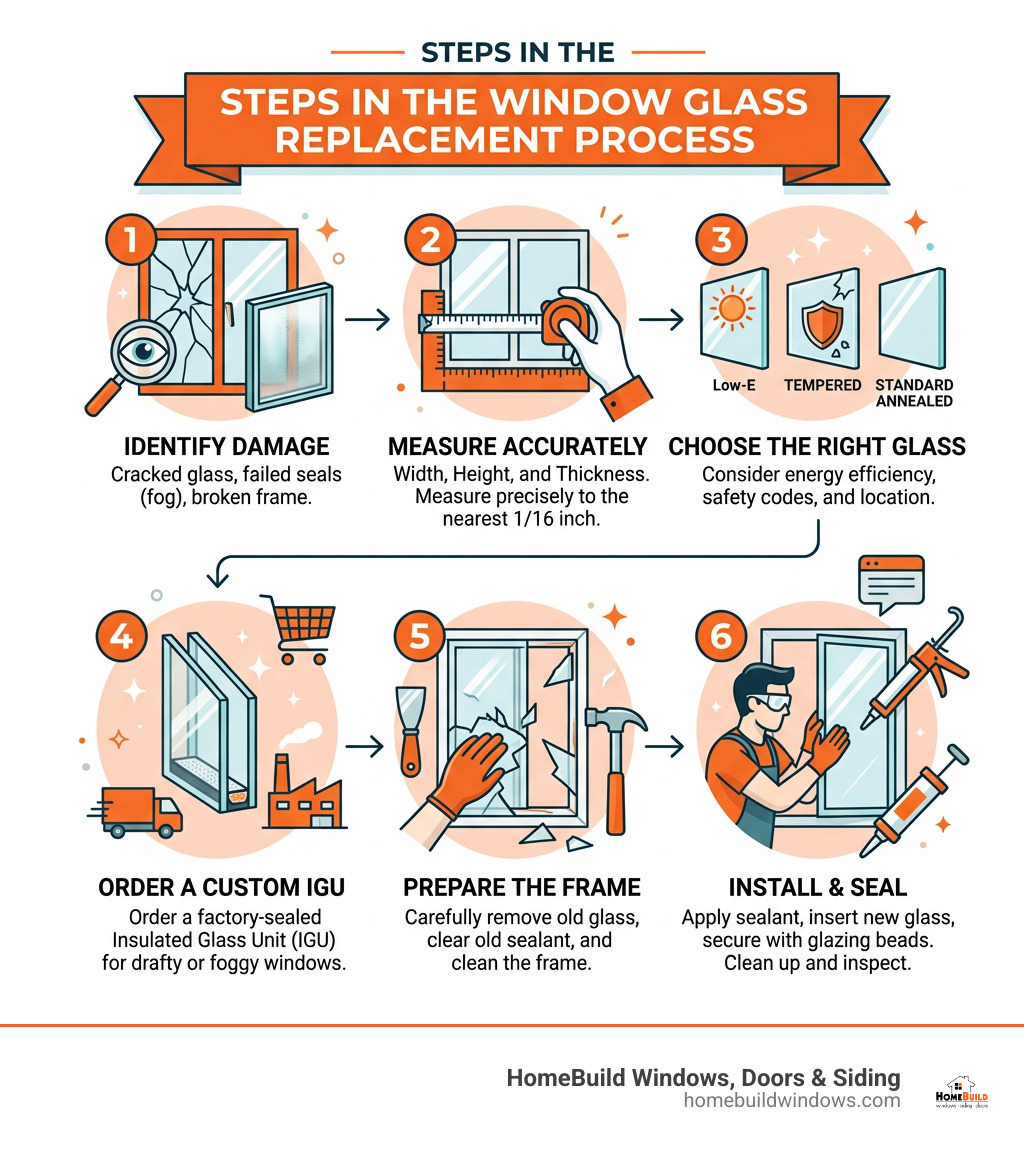
Quick answer: How to replace window glass
- Identify the problem — cracked pane, failed seal (foggy glass), or broken frame
- Measure accurately — width, height, and overall thickness to the nearest 1/16 inch
- Choose the right glass — tempered, Low-E, or standard annealed depending on location and code
- Order a custom IGU — factory-sealed insulated glass units can be ordered online and shipped to your door
- Install or hire a pro — DIY is possible for simple frames; professional installation is recommended for IGUs
Most homeowners don’t realize that replacing just the glass — not the entire window — can save 50–70% compared to a full window replacement. If your frame is solid, there’s a good chance you don’t need to touch it.
But there’s a catch. Not every broken or foggy window is a simple fix. The type of glass, your frame material, and local building codes all affect what you can — and should — do yourself.
That’s where knowing your options makes all the difference.
I’m Steve Mlynek, CEO and founder of HomeBuild Windows, Doors & Siding, and I’ve spent over 20 years helping Chicago-area homeowners navigate exactly this kind of decision — from straightforward window replacement glass swaps to full-frame overhauls. In that time, I’ve seen which repairs hold up and which ones end up costing more in the long run.
Must-know window replacement glass terms:
Understanding Insulated Glass Units (IGUs)
If you live in Chicago or the surrounding suburbs like Arlington Heights or Naperville, you almost certainly have insulated glass units (IGUs) in your home. An IGU isn’t just a single sheet of glass; it is a sophisticated “sandwich” of components designed to keep the brutal Illinois winters out and the summer AC in.
An IGU consists of two (or sometimes three) panes of glass separated by a spacer bar. This spacer creates a gap that is hermetically sealed to prevent outside air from entering. To boost performance, we often fill that gap with inert gases like argon gas or krypton gas. According to the U.S. Department of Energy, these gases are denser than air, which significantly slows down heat transfer.
When you are looking for More info about double pane window replacement, it’s important to understand the “seal.” The seal is what keeps the gas in and moisture out. When this seal fails, you get that dreaded “foggy” look between the panes.
Beyond temperature control, IGUs offer excellent noise reduction, which is a lifesaver if you live near O’Hare or a busy Metra line. They also provide condensation resistance, preventing that interior frost buildup that can rot wood sills over time.
Benefits of upgrading your window replacement glass
When we talk about upgrading your window replacement glass, we aren’t just talking about fixing a crack. We are talking about improving your home’s “thermal envelope.” Here are the key metrics you should know:
- U-Factor: This measures how well the window prevents heat from escaping. The lower the number, the better. A typical high-quality IGU has a U-factor around 0.30.
- R-Value: This is the inverse of the U-factor; it measures the resistance to heat flow. High R-values mean better insulation.
- Solar Heat Gain Coefficient (SHGC): This tells you how much solar radiation comes through the glass. In Chicago, we want a balanced SHGC that allows some “free” heat from the sun in the winter but blocks it in the summer.
By choosing Energy efficient glazing options, you can incorporate Low-E coatings. These are microscopic layers of silver or other low-emissivity materials that reflect heat back to its source. In the winter, it reflects your furnace’s heat back into the room. In the summer, it rejects the sun’s UV rays, protecting your furniture from fading and keeping your HVAC system from working overtime.
Choosing the right window replacement glass for your home
Not all glass is created equal. Depending on where the window is located in your home, building codes in places like Des Plaines or Schaumburg may require specific safety features.
| Glass Type | Strength | Best For | Safety Level |
|---|---|---|---|
| Annealed | Standard | Standard residential windows | Low (breaks into shards) |
| Tempered | 4x Stronger | Doors, bathrooms, low windows | High (breaks into small pebbles) |
| Laminated | High Impact | Security, extreme noise reduction | Highest (holds together when broken) |
| Low-E | N/A (Coating) | All exterior windows | N/A (Efficiency focused) |
Annealed glass is your standard window glass. It’s cost-effective and can be cut on-site, but when it breaks, it creates dangerous jagged shards. Tempered glass, on the other hand, is heated and cooled rapidly to increase its strength. It is required by code if a window is within 24 inches of a door, less than 18 inches from the floor, or located in a bathroom (near a tub or shower).
When you order custom sealed window units, precision is everything. We always recommend measuring to the nearest 1/16 inch. A unit that is even slightly too large won’t fit the frame, and one that is too small won’t seal properly, leading to drafts and premature seal failure.
Selecting window replacement glass for different frame materials
The way you install your window replacement glass depends heavily on what your frames are made of.
- Wood Frames: These are common in historic Chicago bungalows. Replacing glass in wood frames often involves removing old, brittle putty. We recommend using linseed oil on the bare wood before applying new glazing compound. This prevents the wood from sucking the oil out of the putty, which causes it to crack prematurely. You’ll also need glazing points—small metal triangles that hold the glass in place while the compound dries.
- Vinyl Windows: Most modern homes in the North-West Suburbs use vinyl. These typically use “snap-in” glazing beads. You carefully pop these out, replace the IGU, and snap them back in. If you are following an Awning window pane replacement guide, you’ll find that vinyl frames are often the most DIY-friendly.
- Aluminum Channels: Often found in sliding doors or basement windows, these usually use rubber gaskets or silicone sealant to hold the glass.
Whether you are Changing glass on front door or a small basement window, the goal is always a water-tight and air-tight fit.
Step-by-step DIY installation guide
Before you start, gather your tools. You don’t want to be halfway through removing broken glass only to realize you don’t have the right sealant.

Safety First
We cannot stress this enough: wear safety goggles and cut-proof gloves. Even if the glass isn’t currently broken, it can shatter during removal. Tape an “X” over the pane with painter’s tape to keep shards from flying if the glass breaks further.
The Replacement Process
- Remove the Sash: If possible, remove the window sash and lay it flat on a workbench. This is much safer than working on a vertical window.
- Remove Old Glass: For wood frames, use a heat gun to soften old glazing compound, then carefully pry it out with a putty knife. For vinyl, pop the glazing beads.
- Clean the Frame: Scrape away all old sealant, dirt, and debris. If it’s a wood frame, apply a sealer or linseed oil.
- Measure: If you haven’t ordered your glass yet, measure the opening. Subtract 1/16 to 1/8 inch from your measurements to ensure the new unit has room to expand and contract with the Chicago weather.
- Test Fitting: Place the new window replacement glass in the frame “dry” to ensure it fits perfectly.
- Apply Sealant: Apply a thin bead of high-quality silicone sealant or glazing compound along the frame’s inner edge.
- Set the Glass: Carefully press the new IGU into the sealant.
- Final Seal: Reinstall the glazing beads or apply the outer layer of glazing compound. If you’re working on a specific style, check out How to replace glass in an awning window.
If this sounds like a lot of work, you can always search for Window glass fitting near me to find local experts who can handle the heavy lifting.
When to choose glass repair over full window replacement
One of the most common questions we get at HomeBuild is: “Do I need a new window, or just new glass?”
Choose window replacement glass (Glass-only) if:
- The frame is in excellent condition (no rot, no warping).
- The glass is cracked or broken.
- The seal has failed (foggy windows), but the window still operates smoothly.
- You want to upgrade to Low-E glass without the cost of a full renovation.
Choose full window replacement if:
- Rotting Wood: If you can poke a screwdriver into the frame and it sinks in, the wood is gone.
- Frame Warping: If the window is difficult to open or close because the frame has shifted or bowed.
- Lifespan: If your windows are over 15–20 years old, the hardware and frame technology are likely obsolete.
- Major Drafts: If air is leaking through the frame itself, not just the glass.
Our team provides Professional window glass replacement services from HomeBuild Windows across the Chicagoland area. We often perform a cost-benefit analysis for our customers. While glass replacement is cheaper upfront, if the frames are failing, you’ll just be throwing good money after bad.
For those with specialized needs, like a Broken glass door replacement, the decision often leans toward replacement because of the safety requirements for tempered glass in large doors. You can also explore our Window replacement guide: double pane vs triple pane to see if a full upgrade to triple-pane is worth the investment for your specific home.
Frequently Asked Questions about window glass
Can I replace just one pane of a double-pane window?
Technically, no. An IGU is a factory-sealed unit. The space between the panes is filled with special gas and contains a desiccant (drying agent) to prevent moisture. If you break one pane, the seal is gone, the gas has escaped, and the desiccant is saturated. You must replace the entire IGU “sandwich,” not just one slice of bread.
How do I accurately measure for a replacement IGU?
Measure the width and height of the visible glass, then add the amount of glass that is hidden inside the frame (the “bite”). Or, measure the opening and subtract 1/16 inch. Most importantly, measure the overall thickness of the unit (e.g., 1/2″, 5/8″, 7/8″). This is the distance from the outside of the first pane to the outside of the second pane.
Is tempered glass required for all window replacements?
No, but it is required in “hazardous locations.” This includes any glass in a door, glass immediately adjacent to a door, windows near the floor (within 18 inches), and any glass in a bathroom near a shower or tub. Tempered glass is designed to crumble into small, dull pieces rather than sharp shards, which prevents serious injury.
Conclusion
At HomeBuild Windows, Doors & Siding, we believe in giving Chicago homeowners the best value for their money. Whether you are looking for a DIY fix for a cracked pane or you need a full-scale window replacement glass upgrade for your entire home, we are here to help.
We’ve served thousands of neighbors in Barrington, Crystal Lake, Evanston, and throughout the Chicagoland area. We pride ourselves on professionalism, attention to detail, and competitive pricing. If your windows are looking a little cloudy or you’re feeling a draft this winter, don’t wait until your energy bills skyrocket.
Ready to see clearly again? Schedule your window replacement and installation with us today and let our experts ensure your home is beautiful, safe, and energy-efficient for years to come.