



Why Understanding Window Replacement Costs Matters
The cost of replacing windows typically ranges from $300 to $2,500 per window, with most homeowners paying around $550 to $750 per window including installation. For a full house replacement project, expect to invest between $3,000 and $20,000 depending on the number of windows, materials chosen, and installation complexity.
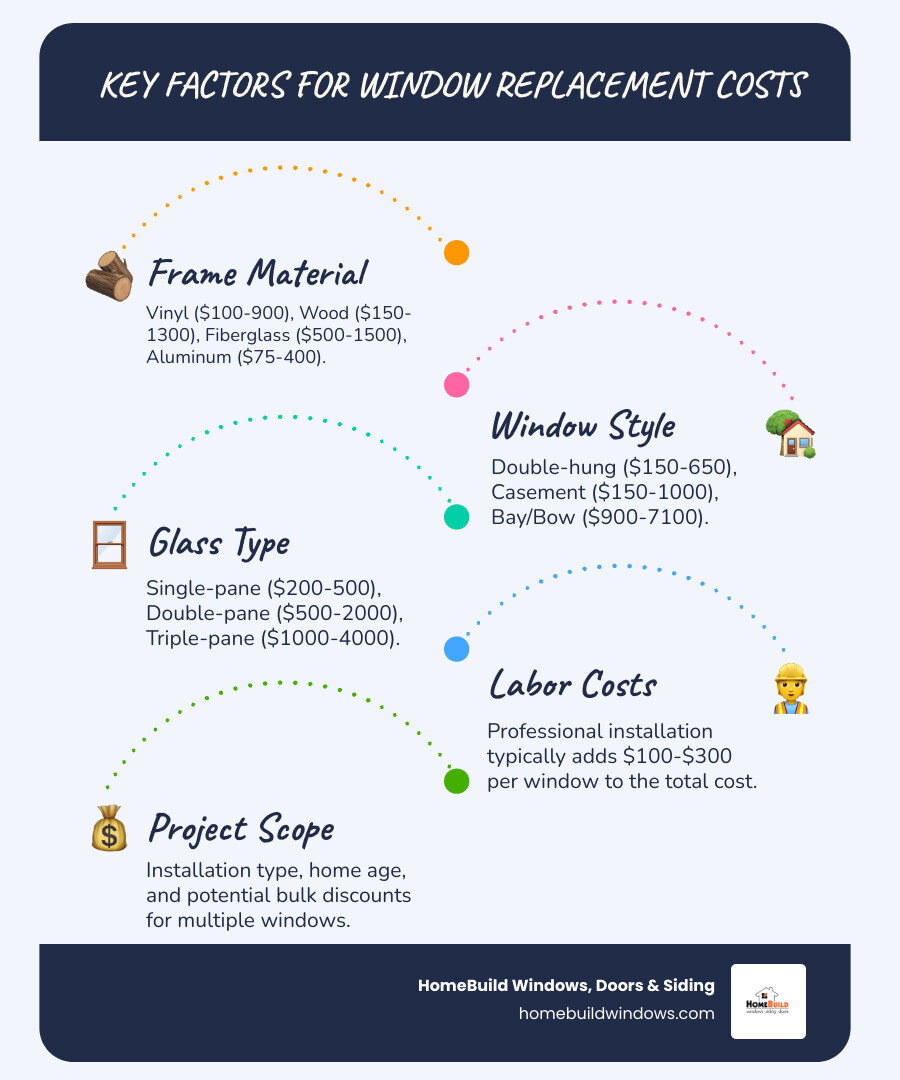
Key factors that determine your final cost:
- Frame material – Vinyl ($100-$900), Wood ($150-$1,300), Aluminum ($75-$400), Fiberglass ($500-$1,500)
- Window style – Double-hung ($150-$650), Casement ($150-$1,000), Bay/Bow ($900-$7,100)
- Glass type – Single-pane ($200-$500), Double-pane ($500-$2,000), Triple-pane ($1,000-$4,000)
- Labor costs – Typically $100-$300 per window for professional installation
- Project scope – Replacing multiple windows at once usually reduces per-window costs
Window replacement represents one of the most significant home improvement investments you’ll make. Whether you’re battling high energy bills from drafty windows, dealing with condensation between glass panes, or simply ready to upgrade your home’s appearance and efficiency, understanding the true cost helps you budget effectively and make informed decisions.
The price range can feel overwhelming at first. Why does one window cost $300 while another costs $2,500? The answer lies in dozens of variables—from the frame material and glass technology to your home’s age and the complexity of installation. Some homeowners report saving up to 13% on energy bills after upgrading to ENERGY STAR certified windows, while others see their home value increase by $14,000 to $16,000 after a full replacement project.
I’m Steve Mlynek, and over the past 20 years, I’ve helped thousands of Chicago-area homeowners steer the cost of replacing windows and make smart investment decisions for their homes. As CEO of HomeBuild Windows, I’ve seen how the right windows—installed correctly—transform homes while delivering real energy savings and comfort improvements.
When Is It Time for a Window Replacement?
Your windows have a way of telling you when they’re ready to retire. Sometimes they shout—a crack appears, a frame rots through—but more often, they whisper. Those whispers come in the form of subtle discomforts that gradually become harder to ignore.
The most common sign? High energy bills that seem to climb year after year. Old windows are terrible at keeping your home’s temperature stable. Heat escapes through them in winter and floods in during summer, forcing your furnace and air conditioner to work overtime. In fact, according to the U.S. Department of Energy, windows can account for 25% to 30% of a home’s heating and cooling energy use. If your bills have been creeping upward and you’re still running original windows from decades ago, they’re likely the culprit.
Drafty rooms are another dead giveaway. You shouldn’t feel a breeze when you’re standing near a closed window. If you do, the seals have failed or the frames have warped over time. That’s not just uncomfortable during Chicago winters—it’s money literally blowing out the window.
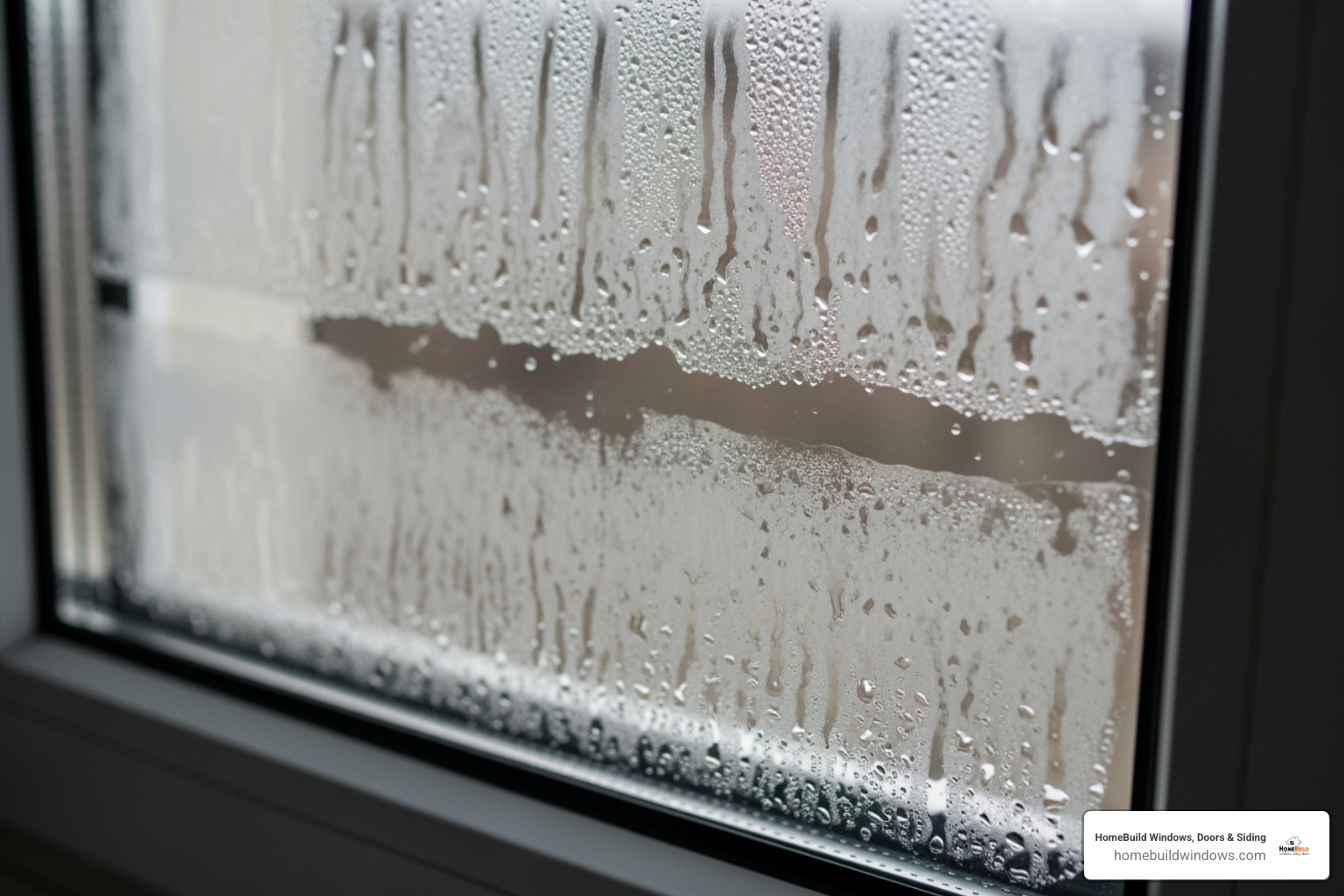
Have you noticed condensation between the glass panes? Not the kind you can wipe away from the outside, but fog trapped inside the glass itself. This means the seal on your insulated glass unit has broken. Once that seal fails, the insulating gas between the panes escapes and moisture gets trapped inside. Your window has essentially lost its ability to insulate properly, and that cloudy view isn’t going to clear up on its own.
Difficulty opening or closing your windows signals that something’s wrong. Maybe they stick, maybe they won’t stay open, or maybe you’ve given up trying altogether. Warped frames and worn hardware aren’t just annoying—they’re safety concerns, especially if you need to exit quickly in an emergency.
Visible damage like rotting wood, cracked vinyl, or peeling paint goes beyond aesthetics. These issues invite water infiltration, which can lead to mold growth and structural problems that extend far beyond the window itself.
And if excessive outside noise has you feeling like you’re living on a busy street even when you’re not, new windows with proper glazing can transform your home into the quiet sanctuary it should be.
Experiencing any of these issues? It’s time to start thinking about the cost of replacing windows and what options make sense for your home. For a deeper look at these warning signs, check out our guide on 4 Reasons Your Home Needs Window Replacement.
Understanding the Average Cost of Replacing Windows
When you’re planning a window replacement project, the burning question is always, “What’s this going to cost me?” The answer, as you might expect, isn’t quite as simple as a single number—but don’t worry, I’ll break it down so you know exactly what to expect.
On a national level, the cost of replacing windows typically falls between $300 and $2,500 per window, with most homeowners landing somewhere around $550 to $750 per window when you include both the unit and professional installation. If you’re replacing just one or two windows, expect to pay toward the higher end of the per-window cost. But here’s the good news: replacing multiple windows at once almost always brings that average down.
For a full house replacement, you’re looking at a total investment between $3,000 and $20,000 for most projects. A typical three-bedroom home with 10 to 15 windows usually runs between $3,000 and $15,000, while larger projects—say, replacing 25 windows—might average $18,000 to $20,000. I know those ranges feel wide, but that’s because every home and every project is different.
Think of it this way: a budget-friendly project might involve standard-sized vinyl windows with double-pane glass and basic hardware. Nothing fancy, but perfectly functional and energy-efficient. On the other end of the spectrum, a premium project could include custom-sized wood or fiberglass frames, triple-pane glass with Low-E coatings, insulating gas fills, and specialized hardware that makes your windows operate like butter.
The real key to managing your budget effectively is understanding what drives these costs up or down. That’s where the details come in—frame materials, window styles, and glass options all play starring roles in your final bill. For a more comprehensive breakdown, check out our Home Window Replacement Cost Guide.
Frame Materials: From Vinyl to Fiberglass
If there’s one decision that’ll make the biggest impact on the cost of replacing windows, it’s choosing your frame material. This isn’t just about price—each material brings its own personality to your home, with different looks, lifespans, and maintenance needs.
Vinyl windows are the workhorse of the window world, and there’s a reason they’re so popular. Costing between $100 and $900 per window, vinyl offers excellent energy efficiency, requires virtually zero maintenance (no painting, no staining), and holds up beautifully against moisture. They’re perfect for homeowners who want quality performance without breaking the bank. The downside? Your color options are somewhat limited, and they’re not quite as strong as some other materials.
Wood windows bring that classic, timeless elegance that many homeowners love, especially in historic or traditional homes. At $150 to $1,300 per window, they’re pricier than vinyl, and they do require regular maintenance—painting or staining every few years to keep them looking their best and protected from the elements. But if curb appeal and authentic charm are priorities, wood is hard to beat. They’re also excellent insulators, which helps with energy efficiency.
Fiberglass windows are the premium choice, ranging from $500 to $1,500 per window. They’re incredibly strong and durable, offer superior energy efficiency, and can be painted to match any color scheme. They resist warping, rotting, and swelling better than any other material, making them ideal for Chicago’s temperamental weather. The main drawback is the upfront cost, but many homeowners find the longevity and performance worth the investment.
Aluminum windows are the budget-friendly option at $75 to $400 per window. They’re strong, lightweight, and virtually maintenance-free. However, aluminum is a conductor, which means these windows aren’t as energy-efficient as other options—they transfer heat and cold more readily. They’re best suited for garages, sunrooms, or commercial applications rather than your main living spaces.
Composite windows combine materials (often wood fibers and polymers) to get the best of multiple worlds—the look of wood with the low maintenance of vinyl. They typically fall in the mid-to-upper price range and offer excellent durability and energy performance.
| Material | Average Cost Range (per window) | Key Pros | Key Cons | Best For |
|---|---|---|---|---|
| Vinyl | $100 – $900 | Low maintenance, energy efficient, moisture resistant, affordable | Limited colors, not as strong as other materials | Budget-conscious homeowners, most climates |
| Wood | $150 – $1,300 | Beautiful aesthetics, excellent insulation, customizable, classic appeal | Requires regular maintenance, higher cost, susceptible to moisture | Traditional homes, homeowners valuing aesthetics |
| Fiberglass | $500 – $1,500 | Extremely durable, superior energy efficiency, paintable, weather resistant | Highest upfront cost, fewer style options | Long-term investment, harsh climates |
| Aluminum | $75 – $400 | Affordable, strong, low maintenance, lightweight | Poor insulation, conducts heat/cold, can corrode | Garages, sunrooms, commercial buildings |
| Composite | $300 – $1,200 | Wood appearance, low maintenance, durable, good insulation | Mid-to-high cost, heavier than vinyl | Homeowners wanting wood look without maintenance |
The right choice depends on your budget, your home’s style, and how much time you want to spend on upkeep. In my experience working with Chicago homeowners, vinyl and fiberglass are the most popular choices—vinyl for value-conscious projects and fiberglass when homeowners want the absolute best performance for the long haul.
Window Styles and Their Price Points
Beyond the frame material, the style of window you choose has a significant impact on the cost of replacing windows. Different styles operate differently, look different, and—you guessed it—cost different amounts.
Double-hung windows are the classic choice you see in most homes. Both the top and bottom sashes slide up and down, making them easy to clean and versatile for ventilation. They typically cost between $150 and $650 per window, making them one of the most budget-friendly options. They work well in almost any room and any architectural style.
Casement windows are hinged on the side and swing outward like a door, operated by a crank mechanism. Priced between $150 and $1,000 per window, they offer excellent ventilation and a tight seal when closed, which translates to better energy efficiency. They’re perfect for hard-to-reach spots like over the kitchen sink. Learn more about Casement Window Replacement on our dedicated page.
Picture windows are fixed panes that don’t open, designed purely to frame a view and flood your room with natural light. Since they don’t have any operating hardware, they’re often more affordable and highly energy-efficient. They’re ideal for living rooms or anywhere you want to showcase a beautiful outdoor view.
Bay and bow windows are the statement pieces of the window world. They project outward from your home, creating extra interior space and adding architectural interest. These beauties range from $900 to $7,100, depending on size and configuration. They’re more complex to install, which adds to the cost, but the impact on your home’s appearance and the additional space they create can be transformative.
Awning windows are hinged at the top and open outward from the bottom, creating an “awning” effect. They’re great for ventilation even during light rain and work well in bathrooms or as accent windows above doors. Sliding windows glide horizontally on a track and are perfect for spaces where you can’t have a window swinging outward.
The style you choose should balance your budget with your home’s needs. Think about how you’ll use each window—do you need ventilation, or is the view the priority? Do you want to make a design statement, or are you looking for simple, functional replacements?
Glass & Glazing Options
Once you’ve chosen your frame material and window style, it’s time to talk about what’s literally at the center of your window—the glass itself. This is where energy efficiency really comes into play, and where your choices can significantly affect both the upfront cost of replacing windows and your long-term energy savings.
Single-pane glass is the most basic option, costing between $200 and $500 per window. It’s just one layer of glass—simple and affordable, but not very energy-efficient by today’s standards. Unless you’re replacing windows in an unheated garage or shed, single-pane isn’t worth considering for your living spaces.
Double-pane glass is the modern standard, featuring two layers of glass with a sealed space between them. This air gap provides much better insulation than single-pane, and the cost ranges from $500 to $2,000 per window. Most new construction and replacement windows today use double-pane as the baseline, and for good reason—they significantly reduce heat transfer and outside noise.
Triple-pane glass takes insulation to the next level with three layers of glass and two insulating air spaces. At $1,000 to $4,000 per window, they’re the most expensive option, but they offer the best energy performance available. In Chicago’s harsh winters, Triple Pane Windows can make a noticeable difference in comfort and heating costs, especially if your home faces extreme weather exposure.
But the number of panes is just the beginning. Low-E (low-emissivity) coatings are microscopically thin metallic layers applied to the glass that reflect heat back to its source. In winter, they keep your heated air inside; in summer, they reflect the sun’s heat away. This invisible coating adds about $50 to $150 per window but can reduce energy loss by up to 50%.
Insulating gas fills—typically argon or krypton—are pumped into the space between glass panes to further reduce heat transfer. Argon is more common and affordable, while krypton offers slightly better performance at a higher cost. These gases are denser than air, making them better insulators, and they add roughly $30 to $100 per window to your cost.
When you combine double or triple-pane glass with Low-E coatings and gas fills, you’re looking at what we call Energy Efficient Glazing. Yes, it costs more upfront, but the energy savings add up month after month, year after year. Many homeowners see a return on their investment through reduced utility bills within just a few years.
The right glass package for your home depends on your climate, your home’s orientation, and your budget. Here in Chicago, I typically recommend at least double-pane with Low-E and argon fill as the sweet spot between performance and cost. But if you’re planning to stay in your home long-term and want maximum comfort and efficiency, triple-pane is worth serious consideration.