



The Real Story Behind Bay Window Pricing
The average cost of bay window and installation ranges from $2,000 to $6,000 for most Chicago homeowners, but your final price depends on several key factors that can push costs higher or lower.
Quick Cost Breakdown:
- Small bay windows (4’x3′): $1,300 – $3,000
- Standard bay windows (6’x3′): $2,000 – $4,500
- Large bay windows (8’x3′): $2,500 – $6,000
- Custom/premium options: $3,500 – $8,000+
Bay windows aren’t just regular window replacements – they’re architectural features that extend from your home’s exterior wall. This means more complex installation, potential structural work, and often a small roof addition. While the upfront investment is significant, bay windows typically increase home value and create that coveted extra space Chicago homeowners love.
The price varies dramatically based on size, materials, and installation complexity. A basic vinyl bay window replacement might cost $2,000, while a custom wood bay window with energy-efficient glass and structural modifications could reach $8,000 or more.
I’m Steve Mlynek, and over my 20 years in Chicago’s window industry, I’ve guided hundreds of homeowners through bay window projects and understand exactly what drives the average cost of bay window and installation in our market. At HomeBuild, we’ve seen how the right bay window can transform both a room’s functionality and a home’s curb appeal.
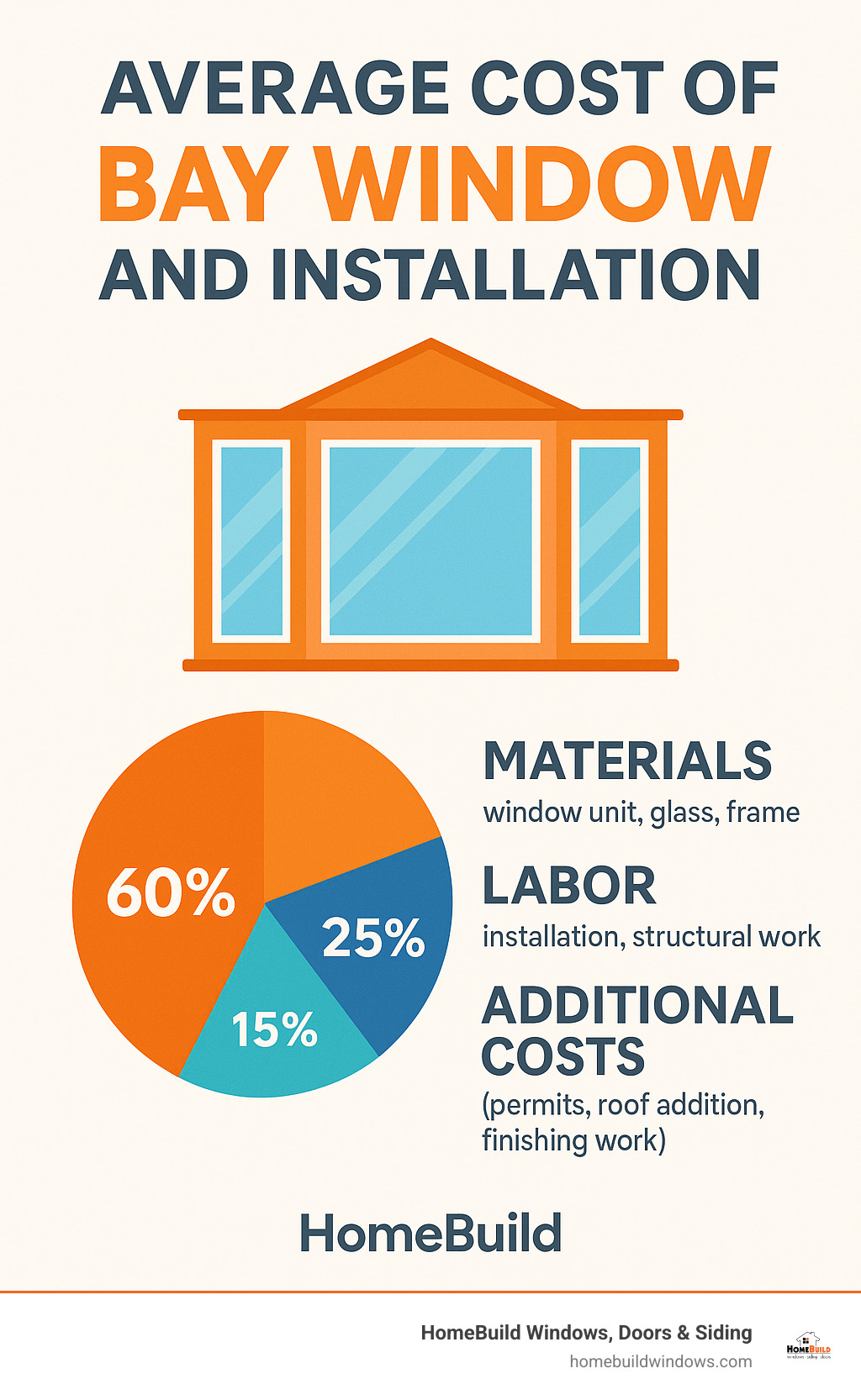
Understanding the Average Cost of Bay Window and Installation
Let’s get straight to the numbers you’re looking for. The average cost of bay window and installation isn’t a one-size-fits-all answer, but I can give you the realistic ranges that most Chicago homeowners face.
National Averages and Price Ranges
Nationally, bay window projects typically run between $950 and $7,500, with most homeowners landing somewhere in the $2,500 to $3,600 range. That’s a pretty wide spread, I know, but there’s a good reason for it.
The low-end cost of around $1,300 gets you a basic 4-foot-wide bay window with standard materials and straightforward installation. On the high-end, you’re looking at $7,500 or more for a large, custom bay window with premium materials and complex structural work.
Here’s something important to consider: replacement versus new construction makes a significant difference in your budget. If you’re replacing an existing bay window, you’ll typically spend $1,800 to $2,500 for labor and materials. But if you’re adding a bay window where none existed before, expect higher costs due to the structural modifications needed.
Location affects pricing too. While the national average sits around $2,500, here in Illinois we typically see costs around $2,400. Compare that to New York at $3,100 or Florida at $2,600, and you’ll see why local market conditions matter.
For a broader look at window replacement costs in general, check out our guide on window replacement cost.
Bay Window Cost by Size
Size is probably the most straightforward factor affecting your final bill. Bigger windows need more materials, more labor, and often more complex installation work. Most bay windows range from 3 to 10 feet wide and 3 to 6 feet high.
| Size (Width x Height) | Average Cost (Window + Installation) |
|---|---|
| 4’x3′ | $700 – $1,800 |
| 5’x4′ | $2,500 (average) |
| 6’x3′ | $900 – $3,500 |
| 6’x4′ | $3,000 (average) |
| 8’x3′ | $950 – $4,000 |
| 5’x5′ | $3,200 (average) |
| 10’x3′ | $1,500 – $7,000 |
| 5’x6′ | $4,500 (average) |
| 6’x6′ | $5,400 (average) |
| 5’x8′ | $6,000 (average) |
| 6’x8′ | $7,500 (average) |
Width and height impact your costs differently. Adding width typically costs more than adding height because of the increased structural support needed. An 8-foot bay window installation, for example, usually runs between $2,300 and $5,000.
Custom sizes will push you toward the higher end of these ranges. If your architectural vision requires non-standard dimensions, expect to pay a premium for the custom manufacturing and specialized installation work.
Bay Window Cost by Type
The style you choose plays a huge role in determining the average cost of bay window and installation. Each type has its own complexity level, and that directly affects your bottom line.
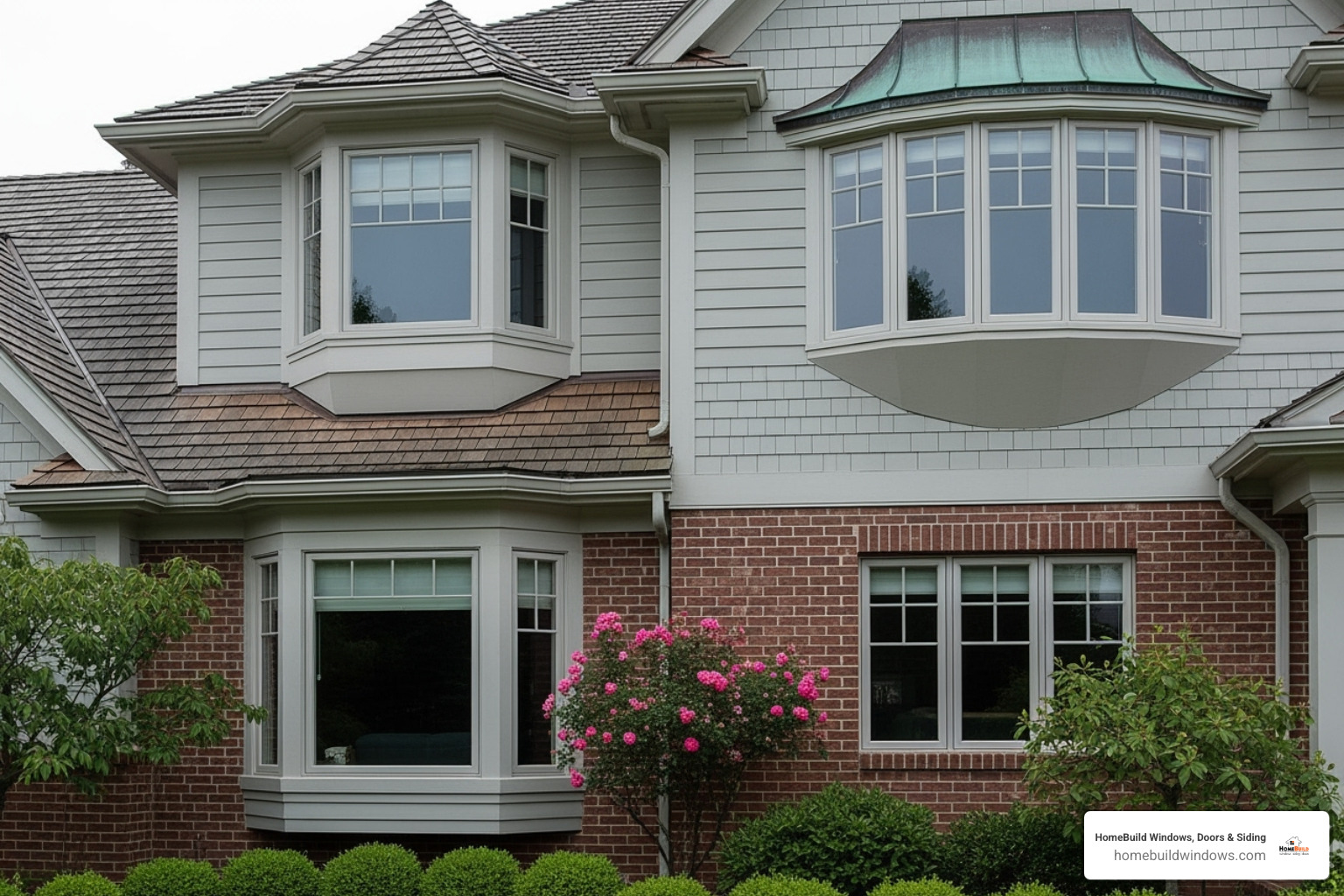
Box bay windows are your most budget-friendly option, typically costing $700 to $1,500. They extend from your wall at 90-degree angles, creating a simple box shape that’s straightforward to install. Some even include a glass top, essentially creating a mini greenhouse in your home.
Canted bay windows (the classic style most people picture) feature a large center window with two angled side panels at 30 or 45 degrees. These are perfect for creating that cozy window seat everyone loves. Expect to pay $1,800 to $6,000 for this traditional look.
Bow windows often get confused with bay windows, but they’re actually more complex. They use four to six equally-sized windows arranged in a gentle arc. The curved design and multiple panels make them the most expensive option, ranging from $1,200 to $8,000, with custom designs reaching $13,000.
Oriel windows are essentially bay windows for upper floors that don’t touch the ground. They’re supported by decorative brackets, giving them an neat floating appearance. The specialized support structure typically costs $900 to $5,000.
Circle bay windows create a pronounced circular projection and are usually custom-made. Their unique curvature makes manufacturing and installation more complex, typically running $2,500 to $6,000.
Each style brings different benefits in terms of light, space, and architectural character. The key is finding the right balance between the look you want and the budget you have. For more ideas on custom window designs that can transform your space, explore our custom window designs options.
Key Factors That Drive Up the Price
Understanding the basics is just the start. The real story behind the average cost of bay window and installation lies in the details – the specific choices you make and the unique requirements of your home. Let me walk you through what really moves the needle on pricing.
Breaking Down the Average Cost of Bay Window and Installation by Material
Here’s something that might surprise you: materials actually make up about 95% of your total bay window cost, with labor representing just 5%. That means your frame choice is absolutely crucial to your budget.
Vinyl frames are the workhorse of the bay window world, and for good reason. At $700 to $3,500 for materials, they offer incredible value. They won’t rot, they don’t need painting, and they handle Chicago’s wild weather swings like champs. For a complete vinyl bay window project, you’re looking at $2,800 to $5,500. It’s why so many of our clients choose vinyl – it just makes sense.
Wood frames bring that timeless elegance that never goes out of style. Yes, they cost more at $1,100 to $6,000 for materials, but there’s something special about natural wood that vinyl can’t match. The trade-off? You’ll need to stay on top of maintenance, especially with our harsh Illinois winters and humid summers.
Fiberglass frames are the goldilocks option – not too cheap, not too expensive, but just right for many homeowners. At $900 to $4,500 for materials, they’re incredibly stable. They won’t expand and contract like other materials, which means fewer problems down the road.
Aluminum frames might seem budget-friendly at $500 to $2,200, but honestly, they’re not great for our climate. They conduct cold like nobody’s business, which isn’t what you want when you’re trying to keep heating bills reasonable.
Steel frames are the premium option at $1,600 to $7,000, but they’re rarely worth it for residential bay windows. They’re heavy, expensive, and overkill for most homes.
Clad frames give you the best of both worlds – wood beauty inside, weather-resistant exterior. At $1,400 to $3,800, they’re a smart middle ground for homeowners who want wood’s warmth without all the maintenance headaches.
Each material affects not just your upfront costs but your long-term satisfaction. For a deeper dive into the most popular choices, check out this helpful guide to wooden frames and vinyl frames.
Labor’s Role in the Average Cost of Bay Window and Installation
Let me be straight with you – bay window installation isn’t a weekend DIY project. This is where experience and expertise really matter, and it shows in both the complexity and cost.
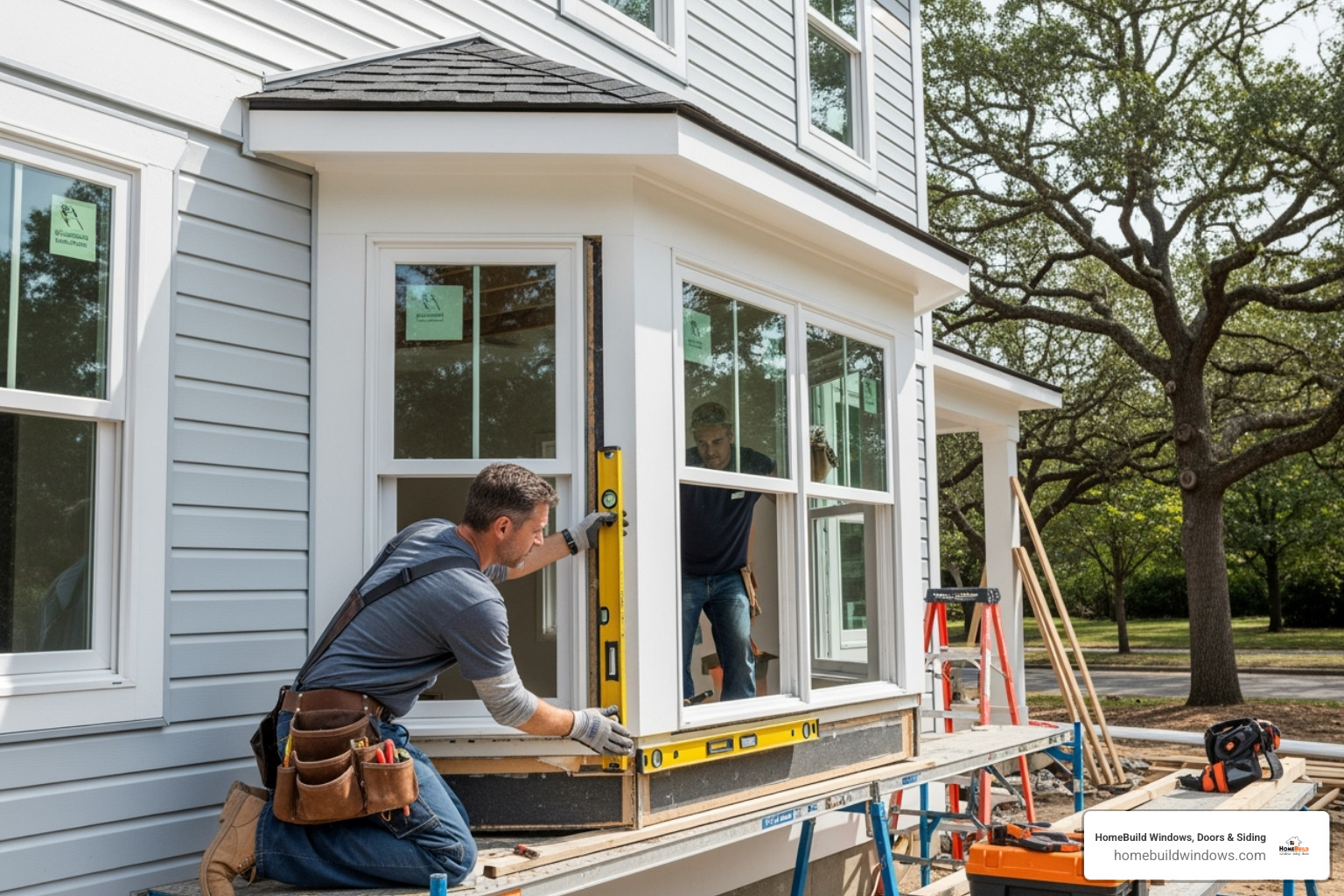
Labor costs typically range from $500 to $2,500, but that can vary dramatically based on your specific situation. A straightforward replacement might take 6 to 12 hours for a standard three-window bay. But if we’re creating a bay window where none existed before? That’s a 1 to 4-day project that requires real expertise.
Upper-floor installations are where things get expensive fast. Working on the second or third story can increase labor costs by 40% to 90%. It’s not just about difficulty – it’s about safety equipment, specialized lifts, and the extra time needed to do everything safely.
Structural work is the big variable that can really impact your budget. If you’re adding a bay window where there wasn’t one before, we’re talking about cutting into walls, adding support headers, and potentially consulting a structural engineer. This work alone averages around $3,000, but it’s absolutely critical. Without proper support, you’re not just risking your window – you’re risking your home’s structural integrity.
At HomeBuild, we’ve seen what happens when bay windows aren’t installed correctly. That’s why we take the structural work seriously and make sure everything is done right the first time. If you’re looking for that level of expertise in the Chicago area, our Chicago Window Installers page has more details about our professional installation services.
Hidden and Additional Costs to Budget For
Here’s where many homeowners get caught off guard. The average cost of bay window and installation includes more than just the window and basic labor. Let me break down the extras you should plan for.
Building permits are almost always required for new bay window installations, especially when structural changes are involved. Budget $50 to $200 for permits, depending on your local municipality. It’s a small price for peace of mind and legal compliance.
Roof additions are usually necessary since bay windows stick out from your home. You’ll need some kind of covering to protect your investment. Shingles run $3 to $15 per square foot, sheet metal costs $4 to $20 per square foot, and if you want to go fancy with copper, expect $11 to $30 per square foot. Overall, plan for $1,800 to $4,600 for the roof addition.
Interior finishing work is where your bay window really comes together. Drywall repair typically runs $200 to $750 if walls were modified. Painting costs $1 to $3 per square foot for walls and $1 to $4 per linear foot for trim, with most painters having a $250 minimum. If you want to add a window seat – and trust me, most people do – that’s another $1,000 to $6,000 depending on how elaborate you go.
Don’t forget about insulation and weather-stripping at $2 to $8 per square foot, debris disposal around $14 to $16, and potential siding repair if the exterior work disturbs your existing siding ($200 to $1,100).
These costs might seem like a lot, but they’re what transform a basic window installation into a beautiful, functional feature that adds real value to your home. When we price out your project, we make sure you know about all these potential costs upfront – no surprises, no hidden fees.
The Value Proposition: Are Bay Windows a Good Investment?
After seeing the average cost of bay window and installation numbers, I understand if you’re wondering whether it’s all worth it. Here’s the honest truth from someone who’s watched homeowners enjoy their bay windows for decades: they’re one of the smartest home improvements you can make.
The Benefits of Installing a Bay Window
Bay windows don’t just change how your home looks – they completely transform how you live in it. I’ve seen families turn bay window nooks into favorite reading spots, watched kids build blanket forts in the extra space, and heard countless homeowners tell me their bay window became the heart of their home.
Increased home value is probably the biggest reason bay windows make financial sense. Studies consistently show that new windows can boost a home’s sale price by over $10,000, with some areas seeing a 6% increase in home value. When future buyers walk through your home, bay windows create those “wow” moments that stick in their memory. They’re timeless features that never go out of style.
The improved curb appeal is immediate and dramatic. Drive down any Chicago street and notice which homes catch your eye – I’ll bet many have beautiful bay windows. They add architectural character that makes your home stand out from cookie-cutter designs, whether your style is classic Victorian or modern contemporary.
Inside your home, bay windows work like magic for natural light. Because they project outward, light streams in from multiple angles instead of just straight through. This means brighter rooms during the day and lower electricity bills year-round. Your morning coffee tastes better when you’re sitting in a sun-filled bay window nook.
The extra floor space might seem small – usually just a few square feet – but it’s amazing how much difference it makes. Some bay windows can add 10 feet or more to your living space. Homeowners use this space for cozy window seats with built-in storage, indoor herb gardens above kitchen sinks, or simply a perfect spot to curl up with a book.
Better views come naturally with bay windows’ multi-panel design. Instead of looking straight out like a picture frame, you get a panoramic view of your surroundings. It’s like bringing the outdoors inside, which feels especially wonderful during our beautiful Chicago summers.
Improved ventilation is an often-overlooked benefit. Many bay window designs feature side panels that open, creating excellent cross-ventilation. This means fresher air circulation and the ability to cool your home naturally on pleasant days.
To see how modern window designs can improve these benefits even further, explore our Modern Home Windows options.
Energy Efficiency and Long-Term Savings
Here’s where bay windows really prove their worth over time. Modern bay windows aren’t just beautiful – they’re surprisingly energy efficient. This matters because windows account for 25% to 30% of your home’s heating and cooling energy use. Get this right, and you’ll see the savings on every utility bill.
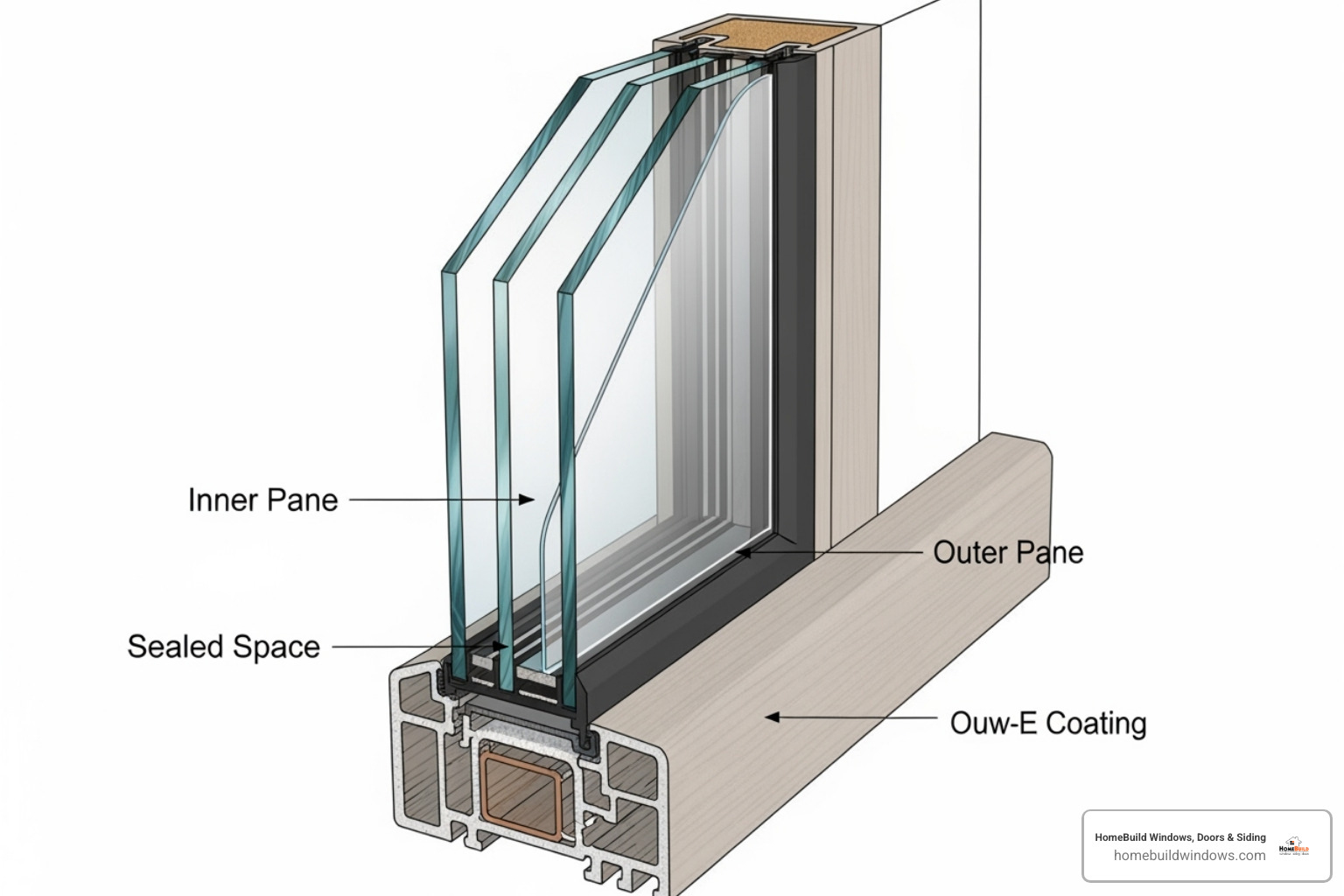
Double-pane windows are the standard for good reason. Two panes of glass with sealed air or gas between them dramatically reduce heat transfer. ENERGY STAR certified double-pane windows can save $27 to $197 annually on energy bills – that adds up to thousands over the window’s lifetime.
Triple-pane windows take efficiency even further with three glass layers and two insulating spaces. Yes, they cost more upfront, but in Chicago’s climate, they often pay for themselves through energy savings. Our Triple Pane Windows page explains why they’re especially valuable in our harsh winters.
Low-E coatings are like invisible shields on your glass. These microscopic layers reflect heat back where it belongs – inside during winter, outside during summer. While they increase material costs by 15% to 35%, the energy savings make them worthwhile for most homeowners.
Argon gas filling between panes provides even better insulation than regular air. It’s colorless, odorless, and slows down heat transfer significantly. For the best performance, some manufacturers use krypton gas, though it’s more expensive.
ENERGY STAR ratings take the guesswork out of choosing efficient windows. These certified products meet strict guidelines and typically deliver a 15% decrease in energy costs compared to older windows. That’s real money back in your pocket every month.
Lifespan and maintenance considerations make bay windows even more attractive financially. A quality bay window, properly installed, typically lasts 20 to 25 years or more. Maintenance is surprisingly simple – annual deep cleaning runs about $28 per bay window professionally, and minor repairs like fixing seals ($120) or hardware ($75) are inexpensive.
More significant repairs like rotted frames ($350 to $600) or glass replacement ($500 to $3,800) are rare when you start with quality materials and professional installation. This is why we emphasize doing it right the first time.
Don’t forget about federal tax credits for energy-efficient improvements. The government offers incentives for qualifying window installations, which can offset some of your initial investment. Check the current offerings at Learn about federal tax credits.
The bottom line? Bay windows pay you back in comfort, beauty, and actual dollars. While the average cost of bay window and installation represents a significant investment, it’s one that keeps giving returns for decades.
Frequently Asked Questions about Bay Window Costs
Over my years helping Chicago homeowners with their window projects, I’ve heard just about every question you can imagine about the average cost of bay window and installation. Let me share the answers to the most common ones that come up during our consultations.
Can you replace a regular window with a bay window?
Absolutely! This is actually one of our most popular projects, and the change is always amazing to see. However, I need to be upfront with you – this isn’t like swapping out one regular window for another. It’s a much more involved process that requires some serious structural work.
Here’s what actually happens when we convert a regular window to a bay window: First, we need to enlarge the opening significantly. Your current window opening simply won’t accommodate a bay window’s outward projection. Then comes the critical part – adding support headers. Bay windows are heavier than regular windows and create different structural loads, so we often need to install new headers and reinforcement framing. Sometimes this means bringing in a structural engineer to ensure everything is properly supported.
Don’t forget about the roof addition either. Since your new bay window will stick out from your home, it needs its own little roof to keep the weather out. Finally, there’s all the interior and exterior finishing work – patching drywall, matching paint, repairing siding, and making everything look like it was always meant to be there.
Professional installation is crucial for this type of conversion. I’ve seen too many DIY attempts that ended up with water damage, structural problems, or windows that just don’t function properly. At HomeBuild, we handle every aspect of the conversion process, from the initial structural assessment to the final paint touch-ups. For more information about our comprehensive approach, check out our Window Installation Services.
Is it cheaper to install a bay window in the off-season?
You bet it can be! This is one of my favorite money-saving tips to share with homeowners who aren’t in a rush to get their project done immediately.
During peak season (spring and summer), everyone wants their windows done at once. Contractors are booked solid, and frankly, we don’t need to offer discounts because demand is so high. But come late fall and winter, things slow down considerably. That’s when you’ll often find better pricing and more flexible scheduling.
Now, I know what you’re thinking – “Installing windows in winter? Won’t my house freeze?” Professional installers like our team at HomeBuild are equipped to work efficiently in colder weather. We use techniques to minimize heat loss during installation and ensure everything is properly sealed. The material prices tend to stay fairly stable year-round, so the real savings come from reduced labor demand.
If you can plan ahead and aren’t in a hurry, scheduling your bay window project for the off-season could definitely help with the average cost of bay window and installation.
How can I save money on my bay window project?
I love this question because it shows you’re thinking smart about your investment. There are several practical ways to manage the average cost of bay window and installation without cutting corners on quality.
Getting multiple quotes is absolutely essential – aim for at least three detailed estimates from reputable companies. Don’t just look at the bottom line though; compare what’s included in each quote. Choosing cost-effective materials like vinyl frames instead of wood can save you thousands while still giving you excellent performance and durability.
Standard sizes are your friend when it comes to saving money. Custom windows always cost more to manufacture, so if your home can accommodate a standard bay window size, you’ll see immediate savings. Local incentives are worth investigating too – beyond federal tax credits for energy-efficient windows, Illinois and some municipalities offer rebates for energy improvements. The DSIRE database is a great resource for finding these local programs.
Consider bundling your project if you’re planning other home improvements. Many contractors, including us at HomeBuild, offer better pricing when you’re doing multiple windows or combining window work with siding projects. Off-season installation can also lead to labor savings, as we discussed.
Finally, think long-term about energy efficiency upgrades. While features like Low-E coatings or argon gas might increase your upfront costs slightly, they’ll save you money on energy bills for decades to come. Sometimes spending a little more initially actually saves you money in the long run.
The key is finding the right balance between your budget and your goals. We work with homeowners every day to find solutions that fit both their vision and their wallet.
Conclusion
After exploring all the factors that influence the average cost of bay window and installation, it’s clear that this investment goes far beyond simply replacing a window. You’re essentially adding an architectural feature that transforms both the interior and exterior of your home.
Yes, spending $2,000 to $6,000 (or more for premium options) is a significant financial commitment. But when you consider that bay windows typically increase your home’s value, create extra living space, flood rooms with natural light, and boost curb appeal, the math starts to make sense. Most homeowners find that the daily joy of their new bay window makes every dollar worthwhile.
The key to a successful project is understanding that professional installation is absolutely essential. Bay windows aren’t just bigger regular windows – they require structural modifications, proper support, weatherproofing, and often a small roof addition. Attempting this as a DIY project or choosing an inexperienced installer can lead to expensive problems down the road.
At HomeBuild Windows, Doors & Siding, we’ve guided hundreds of Chicago-area homeowners through bay window projects over the past two decades. We understand the unique challenges of our Illinois climate and the architectural styles common in Chicagoland neighborhoods. Our team handles everything from structural assessments and permit applications to the final interior finishing touches.
What sets us apart is our commitment to transparency. We provide detailed quotes that break down materials, labor, and any additional costs upfront – no surprises or hidden fees. Our goal is to help you make an informed decision that fits both your vision and your budget.
Whether you’re dreaming of a cozy breakfast nook, a sunny reading corner, or simply want to brighten up your living room, we’re here to make it happen. Our attention to detail and professional installation ensures your bay window will perform beautifully for decades to come.
Ready to start your bay window journey? For a detailed consultation and transparent quote custom to your specific project, explore our Bay Windows Replacement services. We’re excited to help transform your home with the perfect bay window solution.


