


Services

Architectural Shingle Roofing in Chicagoland
Why the Upgrade Matters and How to Choose Right


4.9/5
(180+ Reviews)
Angi Super Service Award
2025
Nextdoor Faves
2025
Owens Corning
Certified Installer
Architectural shingles - also called dimensional or laminate shingles - have replaced standard 3-tab shingles as the dominant residential roofing product in North America.
They are not a premium upgrade available only on high-end homes. They are the current standard, installed on the majority of new and replacement roofs across Chicagoland today.
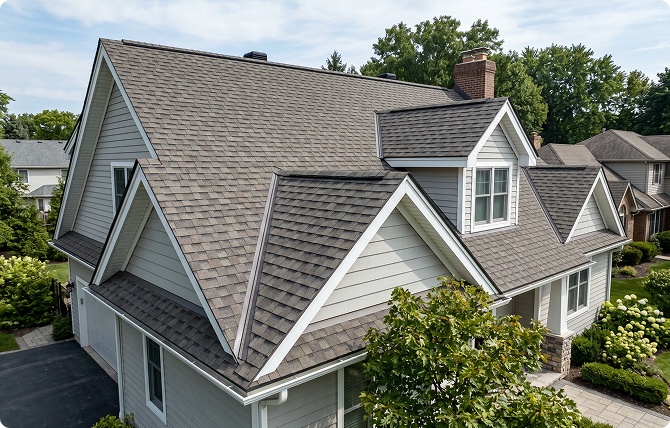
The reason is performance. Architectural shingles are thicker, heavier, and more wind-resistant than 3-tab shingles. They last longer, look better from the street, and handle hail and freeze-thaw cycles that single-layer 3-tab shingles were not designed to withstand.
This page covers the category – what architectural shingles are, how they compare to 3-tab, what the Chicagoland climate case for them looks like, what separates a high-performing architectural shingle from a commodity one, and which specific product HomeBuild Roofing installs and recommends. For product-level detail on that specific shingle, see the Owens Corning TruDefinition Duration page.
What Is the Difference Between Architectural Shingles and 3-Tab Shingles?
The two main categories of asphalt residential shingles differ on every performance dimension:
3-tab shingles:
- Single-layer construction, flat and uniform
- Wind resistance: 60 to 70 MPH
- Service life: 15 to 20 years
- No meaningful impact resistance rating
- Lower upfront cost
Architectural shingles (dimensional / laminate):
- Multi-layer laminated construction, three-dimensional surface
- Wind resistance: 80 to 130 MPH depending on product
- Service life: 25 to 30+ years
- Class 3 or Class 4 impact resistance on premium lines
- Higher upfront cost — lower per-year cost over full service life
Architectural shingles are approximately 50% heavier than 3-tab shingles, with stronger adhesive bonding and significantly better performance across all weather conditions common to the Chicago metropolitan area.
Architectural Shingles Replaced 3-
Tab as the Residential Roofing Standard for a Measurable Reason
For homeowners in Schaumburg, Hoffman Estates, and across the Northwest suburbs who are still on original 3-tab shingles from the 1990s, understanding why the industry shifted away from 3-tab helps put the replacement decision in perspective.
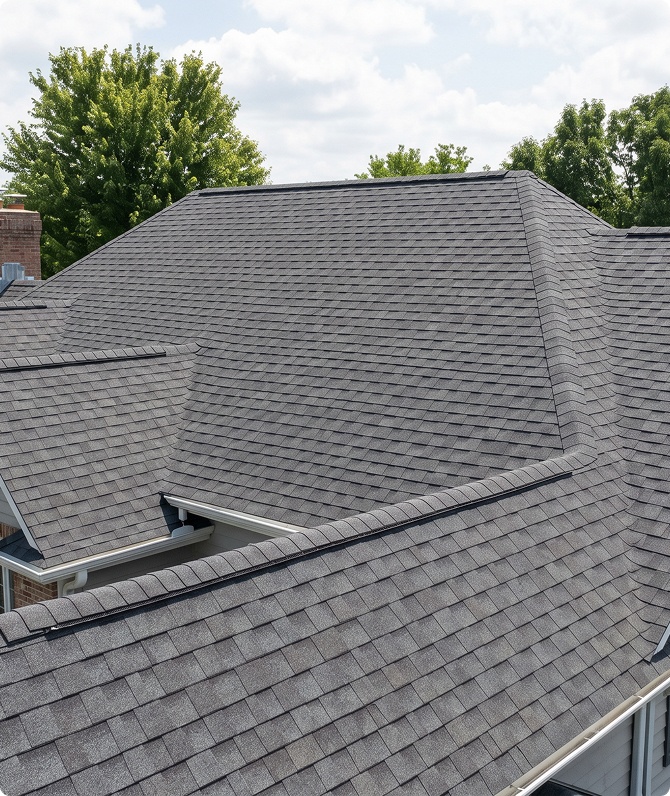
3-tab shingles were the dominant residential roofing product for most of the 20th century. They are simple: a single layer of asphalt-saturated fiberglass mat, covered with mineral granules, cut into strips with three evenly spaced tab sections.
Each strip is approximately 12 inches wide, weighing between 200 and 250 pounds per roofing square. They lay completely flat and create a clean, uniform, two-dimensional pattern across the roof.
That simplicity is also the limitation. A single layer of material means limited wind resistance – typically 60 to 70 MPH for standard 3-tab installation. The uniform flat profile gives wind a consistent surface to work against at every tab edge. The thinner asphalt layer is more vulnerable to hail impact, UV degradation, and freeze-thaw stress. And the flat appearance, while clean when new, shows age and granule loss more visibly than dimensional alternatives.
Architectural shingles – also called dimensional or laminate shingles – address all of these limitations through construction. Two or more layers of asphalt mat are fused together under heat and pressure, creating a shingle approximately 50% heavier than a 3-tab at 250 to 400 pounds per roofing square. The laminated layers create genuine three-dimensional surface depth. Stronger adhesive strips bond adjacent shingle courses together, raising the effective wind resistance threshold to 80 to 130 MPH depending on the specific product. And the greater mass – more asphalt, more granules, a thicker fiberglass mat – handles UV, freeze-thaw, and impact stress better across a longer service life.
Architectural shingles did not replace 3-tab because of marketing. They replaced it because they perform measurably better in every climate condition that matters – and the performance difference is especially pronounced in environments like Chicagoland.
Chicagoland's Climate Makes the Architectural Shingle Upgrade More Than Cosmetic
The case for architectural shingles over 3-tab is strong in any climate. In Chicagoland specifically, it is the difference between a shingle that is likely to perform to its rated service life and one that regularly fails ahead of schedule.
Three Chicagoland climate factors drive this:
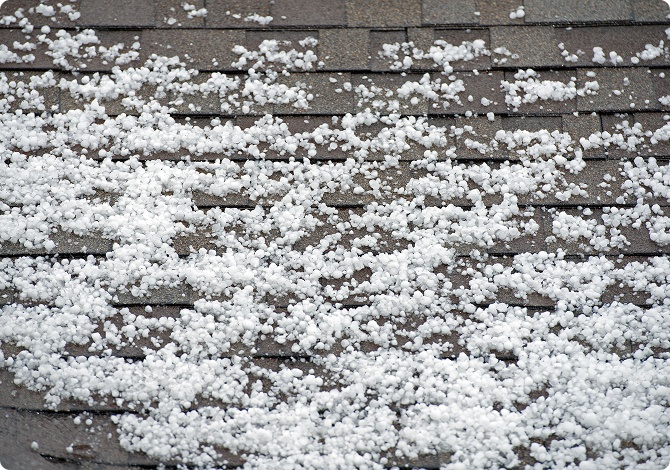
The hail belt position.
The Chicago metropolitan area sits in one of the highest-frequency hail corridors in the Midwest. Severe hail events – producing stones from 1 inch to 2 inches in diameter – pass through the Northwest suburbs multiple times per season. Standard 3-tab shingles have no meaningful Class-rated impact resistance.
A 1-inch hailstone striking a 3-tab shingle creates granule loss, soft impact spots, and accelerated UV degradation – often across an entire roof in a single storm event. Premium architectural shingles carry Class 3 impact ratings – designed specifically for the hail size range common in Illinois severe weather. The difference between a Class 3 shingle and an unrated 3-tab is the difference between a roof that handles a hail event and one that generates an insurance claim.
Summer storm wind speeds.
Chicagoland summer storms regularly produce sustained winds of 60 to 80 MPH and gusts above 90 MPH during severe events. Standard 3-tab shingles are rated to approximately 60 to 70 MPH.
Premium architectural shingles with SureNail-style reinforced nailing zones are rated to 130 MPH. A 3-tab shingle operating at the upper edge of its wind rating in a summer storm is a shingle generating lifted tabs, broken seals, and missing sections. An architectural shingle at 60 to 70 MPH is operating well below its performance threshold.

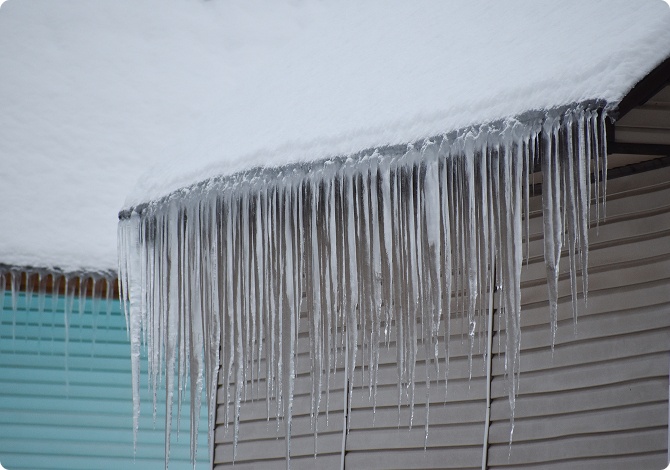
Freeze-thaw cycling.
Chicagoland winters run through dozens of freeze-thaw cycles between December and March. Each cycle flexes the shingle and its adhesive bond.
3-tab shingles – thinner, with single-layer construction – experience adhesive fatigue and tab lifting at the eave line earlier and more frequently than architectural shingles under the same cycling. The thicker laminated construction of architectural shingles maintains its bond integrity longer across repeated thermal stress. The result is a shingle that still seals flat against the deck after 15 Chicagoland winters, rather than one that has lifted tabs and compromised edges.
Taken together, these three factors explain why 3-tab roofs in Chicagoland regularly fall short of their rated 15 to 20-year service life, while properly installed architectural shingles regularly reach or exceed their rated life.
The Cost Difference Between Architectural and 3-Tab Shingles Narrows Significantly Over a 25-Year Roof Life
The upfront cost comparison between architectural and 3-tab shingles is real – architectural shingles cost more to purchase and, in most cases, marginally more to install. For homeowners evaluating a roof replacement in Palatine, Arlington Heights, and across Chicagoland, the relevant comparison is not the day-one number. It is the per-year cost of ownership across the full service life of each option.
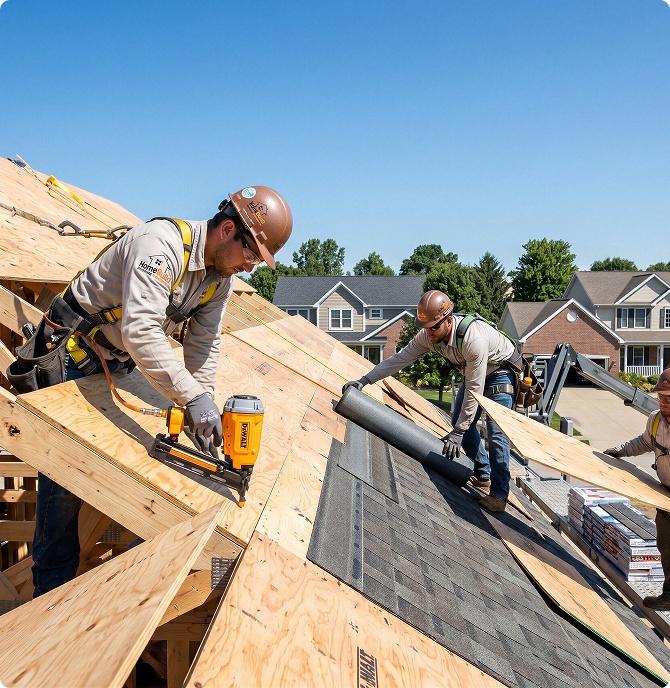
The math works like this. A 3-tab roof has a rated service life of 15 to 20 years. In Chicagoland's hail and wind environment, that rated life often runs shorter in practice - 12 to 15 years before enough wear or storm damage accumulates to justify replacement. An architectural shingle roof on the same home is designed for 25 to 30+ years of service - and in Chicagoland conditions, it tends to perform closer to its rated life because the product is built for these specific stresses.
When you divide the total project cost by the number of years of expected service, the per-year cost difference between architectural and 3-tab narrows considerably. In many scenarios, architectural shingles cost less per year of protection over the full ownership period — even accounting for the higher upfront investment.
Three additional factors strengthen the cost case for architectural shingles in Chicagoland:

Repair frequency.
Architectural shingles generate fewer storm-related repair calls – lifted tabs, cracked sections, and granule loss – over their service life than 3-tab shingles in the same climate. Each avoided repair visit represents a cost that the 3-tab option eventually accumulates.
Insurance considerations.
In some Illinois markets, Class 3 or Class 4 impact-resistant architectural shingles qualify for homeowners insurance discounts. The discount depends on the carrier and policy – worth asking your insurer before selecting a shingle.
Resale value.
In the Northwest and West suburban real estate market, a roof with documented architectural shingle installation and significant remaining service life is a measurable positive in buyer perception and inspection outcomes. A buyer comparing two comparable homes – one with a 5-year-old architectural shingle roof, one with a 10-year-old 3-tab roof – will assess the roofing condition differently.
Four Qualities Separate a High-
Performing Architectural Shingle
From a Commodity Product
Not all architectural shingles are equal. The category spans a wide range – from basic laminate shingles that meet code requirements but not much more, to premium engineered products designed specifically for severe-weather performance. For homeowners in Palatine, Arlington Heights, and across the Northwest suburbs, understanding what to look for helps evaluate competing quotes that may appear similar on the surface.
1
Wind resistance rating and nailing zone design.
The minimum acceptable wind resistance for an architectural shingle in Chicagoland is 110 MPH. Premium products reach 130 MPH. But the rating number alone does not tell the full story – the nailing zone design determines whether that rating is achievable in real installation conditions. A defined, reinforced nailing zone (like Owens Corning’s woven fabric SureNail strip) produces consistent wind resistance across the full roof. An unmarked asphalt nailing zone produces variable results depending on the precision of each individual nail placement.
2
Impact resistance rating.
Class 3 impact resistance (UL 2218 standard) covers hail up to 1.75 inches. Class 4 covers hail up to 2 inches – the highest category available. In Chicagoland’s hail environment, Class 3 is the minimum worth specifying on a new roof. Some premium architectural shingles carry Class 4 ratings. Ask specifically for the UL 2218 classification when evaluating options — not all products advertised as “impact resistant” carry a formal rating.
3
Color technology and long-term appearance.
Standard granule formulations fade and wash out over 5 to 8 years in Midwest UV conditions. Premium shingles use engineered granule platforms – like Owens Corning’s TruDefinition technology – that maintain color depth and contrast significantly longer. For a roof that will be on the home for 25+ years, the difference between standard granules and engineered color granules is visible from the street within 10 years.
4
Manufacturer warranty structure.
A full warranty package for an architectural shingle should include: a Limited Lifetime materials warranty, a formal wind resistance limited warranty (not just a stated rating), and an algae protection limited warranty. All three components should be in writing and require installation to the manufacturer’s published specifications. If any of the three is absent or vague, that is a product-quality signal worth noting.
For Chicagoland Homes, Owens Corning TruDefinition Duration Is HomeBuild's Standard Architectural Shingle
When HomeBuild Roofing evaluates architectural shingle options for Chicago’s Northwest and West suburbs, four criteria drive the recommendation: wind resistance, impact resistance, color longevity, and warranty completeness. One product meets all four clearly and consistently.
Owens Corning TruDefinition Duration shingles check every box:

Wind resistance
130 MPH limited warranty through SureNail Technology – a patented woven fabric nailing strip that creates a triple-layer reinforcement zone. The highest wind resistance rating in the standard architectural shingle category.
Impact resistance
Class 3 UL 2218 rating – covering the hail size range most common in Chicagoland severe weather events.
Color longevity
TruDefinition color platform – specially engineered granules that maintain color depth and contrast significantly longer than standard granule formulations.
Warranty
Limited Lifetime on materials, 130 MPH wind resistance limited warranty, and StreakGuard 10-year algae protection limited warranty – a complete three-component warranty package.
HomeBuild partners with Owens Corning and installs Duration as the standard shingle recommendation for homeowners in Wheaton, Elmhurst, and across the West suburbs - and throughout the Northwest suburban market. It is not the only architectural shingle available; it is the one that consistently performs to specification in this specific climate.
For full product detail - SureNail technology specifications, TruDefinition color options, warranty terms, and sample viewing - see the dedicated Duration shingles page.
Architectural Shingle Roofing Across Chicago's Northwest and West Suburbs
HomeBuild Roofing installs architectural shingles across Chicago’s Northwest and West suburban communities – the markets we know best and where we have been installing Owens Corning products for more than 20 years.
Northwest Suburbs
West Suburbs
Every estimate is free and includes physical shingle samples so you can evaluate color and texture options in natural light at your home before making a selection.
Frequently Asked Questions About Architectural Shingle Roofing in Chicagoland
What are architectural shingles?
Architectural shingles – also called dimensional or laminate shingles – are the current standard residential roofing product. They are constructed from two or more layers of asphalt mat fused together under heat and pressure, creating a thicker, heavier shingle with a three-dimensional surface profile. They replaced standard 3-tab shingles as the dominant product because they perform measurably better across every performance dimension that matters in Chicagoland.
What is the difference between architectural and 3-tab shingles?
The main differences are construction, weight, wind resistance, and service life. 3-tab shingles are single-layer, weighing 200-250 lbs per square, with 60-70 MPH wind resistance and 15-20 year rated service life. Architectural shingles are multi-layer laminated, weighing 250-400 lbs per square, with 80-130 MPH wind resistance depending on product, and 25-30+ year rated service life. In Chicagoland’s hail and wind environment, architectural shingles also perform closer to their rated life than 3-tab shingles, which regularly fall short.
How long do architectural shingles last in Chicagoland?
Premium architectural shingles installed correctly on a properly ventilated roof typically perform 25 to 30+ years in Chicagoland conditions. 3-tab shingles rated for 15 to 20 years frequently fall short of that in the Chicago market – hail, wind, and freeze-thaw cycling accelerate wear on thinner single-layer products. The gap between rated service life and actual performance is significantly smaller with architectural shingles.
Are architectural shingles worth the extra cost?
Yes – when evaluated over the full service life rather than day-one cost. A 3-tab roof lasting 12 to 15 years in Chicagoland conditions costs more per year of protection than an architectural shingle roof lasting 25 to 30 years, even accounting for the higher upfront investment. Add fewer storm-related repair calls, potential insurance discounts for Class 3 or 4 impact-rated products, and stronger resale positioning, and the cost case for architectural shingles is straightforward.
What makes architectural shingles better for Chicago weather?
Three Chicagoland-specific factors make architectural shingles the right choice. First, hail exposure – Class 3 impact-rated architectural shingles handle the 1-1.75 inch hail common in Illinois severe weather; unrated 3-tab shingles do not. Second, wind – premium architectural shingles are rated to 130 MPH; 3-tab shingles top out at 60-70 MPH, which is within the range of a Chicagoland summer storm. Third, freeze-thaw cycling – the thicker laminated construction of architectural shingles maintains adhesive bond integrity across Chicagoland’s 40+ annual freeze-thaw cycles better than single-layer 3-tab construction.
Which architectural shingle does HomeBuild recommend for Chicagoland homes?
Owens Corning TruDefinition Duration shingles. They carry a 130 MPH wind resistance limited warranty through SureNail Technology, Class 3 UL 2218 impact resistance, TruDefinition engineered color granules for long-term appearance, and a complete warranty package including Limited Lifetime on materials, 130 MPH wind, and 10-year StreakGuard algae protection. HomeBuild brings physical Duration samples to your home so you can evaluate color and texture in natural light before making a selection.
Ready to Replace a 3-Tab Roof or Upgrade to a Better Architectural Shingle?
A free on-site estimate. Physical shingle samples at your door. An honest recommendation based on your specific roof, your home, and what Chicagoland weather actually demands. Owner-supervised installation by a team that has been putting architectural shingles on Northwest suburban roofs for more than 20 years.